

DMV-to-Mexico Wedding Blueprint: 5 Tips for a Seamless Destination Wedding | The Goat Audio
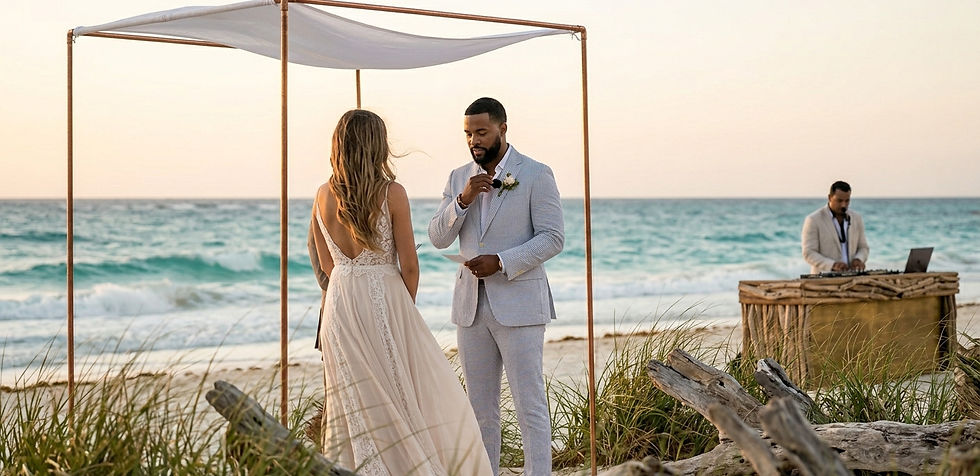
Planning a wedding from the Washington D.C. area brings a unique set of challenges. We are used to efficiency, high-level production, and direct flights. When you transition that vision to the relaxed shores of Mexico, things can get "lost in translation" without a strategic plan.
Whether you are flying out of Dulles (IAD) or Reagan National (DCA), here is how to navigate the logistics of a July destination wedding like a pro.
DMV couples have a reputation for expecting excellence. You've attended black-tie galas at the Kennedy Center, corporate events at the Willard InterContinental, and weddings at the most sought-after estates in Loudoun County. That standard doesn't disappear when you cross the border. If anything, it becomes more important, because the margin for error at a destination wedding is razor thin. You can't call in a backup vendor. You can't swing by the office to grab something you forgot. Every decision you make in the planning stage is the decision you live with on the day. These five tips are built around that reality.
1. Leverage a Liaison (The "Secret" to Saving Thousands)
Many couples think they can handle resort coordinators on their own. However, a specialized agent like Sharon Kopp at Barefoot Bridal does more than just book rooms. She acts as a logistical liaison between you and every layer of the resort's management structure.
One of the biggest hurdles for D.C. couples is the "Outside Vendor Fee." Resorts often charge a premium to bring in your own pros. Sharon specializes in negotiating these contracts, often finding ways to waive fees or secure "Talent-Only" rates. This advocacy is crucial because it allows you to bring the US-based experts you trust without paying a double premium to the resort.
Here's what most couples don't realize: that outside vendor fee isn't a fixed cost. It's a negotiation point. Resorts set those fees high because most couples either pay without questioning it or give up and use the in-house team. Sharon has been through this process enough times to know exactly where the flexibility is. She understands the difference between a resort that will waive the fee entirely for talent-only vendors and one that will reduce it by half if you frame the arrangement correctly. That knowledge alone can save you $2,000 to $5,000 before your team even books a flight.
For DMV couples who are used to working with planners and coordinators who operate at a high level, think of Sharon as your equivalent of a government liaison. She knows the system, she knows the people, and she knows how to get things done without the bureaucratic headaches landing on your plate.
2. The Customs Trap: Rent Gear, Fly in Talent
Mexico is notoriously strict with electronics. Currently, professional gear valued over a certain threshold is subject to a 16% Value Added Tax (IVA) and potential import duties at customs.
The Pro Tip: Never ask your team to pack heavy speakers or lighting rigs. The most cost-effective strategy is to have Sharon coordinate with a local Mexican production house to rent the "heavy lifting" hardware. This keeps your budget focused on the talent.
For example, for our July wedding, we are utilizing The Goat Audio, a premier name for those seeking a wedding DJ in Washington D.C. or elite audio services in Virginia. By renting the speakers in Mexico and flying in the DJ's expertise, you avoid the 16% tax and ensure the "D.C. Signature Sound" is present at your reception.
Let's put real numbers on this so you understand the scale. A professional DJ and production team traveling to a destination wedding might normally bring $15,000 to $25,000 worth of equipment: powered speakers, subwoofers, wireless microphone systems, lighting rigs, backup gear, cables, and cases. At a 16% IVA, that's $2,400 to $4,000 in taxes alone, and that's before any additional import duties or the hassle of clearing customs, which can take hours and sometimes involves equipment being held until departure.
Renting equivalent gear locally in Mexico typically costs $1,500 to $3,000 for a full wedding setup. So instead of paying $4,000 in taxes on top of the cost of your own equipment, you're paying a fraction of that for local rentals while your DJ arrives with nothing but a laptop bag and a carry-on. The sound quality doesn't change. The performance doesn't change. What changes is that you just saved thousands and eliminated the single biggest logistical risk of a destination wedding.
This is the same approach that touring musicians and corporate event producers use. The talent travels light. The gear is sourced locally. It works because the skill is in the hands, not the hardware. A great wedding DJ can walk into any venue with a properly spec'd local sound system and deliver the same performance they would at a reception in Georgetown or a vineyard wedding in Middleburg. If you want to understand what separates a skilled DJ from someone who's just pressing play, my guide on what to look for in a wedding DJ breaks it down.
3. Timing the "July Heat"
A July wedding in Mexico is stunning, but the humidity is a real factor. When planning your timeline, consider the "Golden Hour" carefully. In the DMV, we're used to long summer evenings, but in Mexico, the sun drops faster.
Ceremony Timing: Aim for 30 minutes before sunset to capture the best light without the midday heat. In July, sunset in Cancun hits around 7:15 PM and in Los Cabos around 7:45 PM. That means your ceremony should start between 6:30 and 7:00 PM. This gives your photographer the golden light for portraits and keeps your guests comfortable instead of wilting in the afternoon sun.
Guest Comfort: Work with Sharon to ensure your room block includes "Late Check-Out" options or hospitality suites for guests arriving on early flights from the East Coast.
Sound Curfew Planning: Here's a timing factor that catches most couples off guard. Mexican resorts enforce strict noise curfews, typically between 10 and 11 PM. If your ceremony starts at 6:30, cocktail hour runs from 7:00 to 7:45, and dinner service begins at 8:00, you're looking at roughly two hours of dancing before the curfew kicks in. That's tight.
An experienced DJ plans the entire flow of the night around this constraint. That means the dance floor needs to be open and energized by 9:00 PM at the latest, the peak moments (the hora loca, the big group dance numbers, the songs everyone's been waiting for) need to happen between 9:00 and 10:30, and the transition to a low-volume close needs to feel intentional rather than like someone pulled the plug. If you've ever read my wedding DJ timeline guide, you know how much the flow of the evening depends on getting the timing right. At a destination wedding with a hard curfew, that skill is even more critical.
A resort DJ typically plays until the manager walks over and tells them to stop. A professional DJ has already mapped the entire arc of the night so your guests never feel the party ended too soon.
Build in Buffer Time: Mexico runs on a more relaxed schedule than D.C. Build 15 to 20 minutes of buffer into every transition. The shuttle from the hotel to the venue might run late. The catering team might need an extra few minutes. Your photographer might want five more minutes for sunset portraits. If your timeline is packed tight with zero margin, one delay cascades through the entire evening. A little flexibility in the schedule prevents a lot of stress on the day.
4. Cinematic Documentation
If you are investing in a destination wedding, your media team is your most important "export." This is the one aspect of your wedding that lives forever. The flowers die. The food is eaten. The decorations come down. But the video and photos are what you'll watch on your anniversary, show your kids, and share with the friends who couldn't make the trip.
Using a US-based videographer like High Skies Media ensures that your wedding film has the cinematic, high-end polish that D.C. couples expect. Since they are "Talent-only" and use rented local gear or compact professional kits, Sharon can often help navigate their entry so they can focus on capturing your story.
The coordination between your media team and your DJ matters more than most couples realize. When the first dance starts, the videographer needs to be in position. When the MC introduces the wedding party, the camera needs to be rolling. When the dance floor peaks, the filmmaker needs to know it's coming so they can capture the energy from the right angle. That kind of coordination doesn't happen if your DJ and your videographer meet for the first time 30 minutes before the ceremony.
By flying in a team that has worked together before, or at minimum has been in contact throughout the planning process, you get a wedding film that actually captures the moments as they felt, not just as they looked. The audio from your MC's introductions layered under the footage of your guests reacting. The live saxophone solo synced with the sunset footage. These are the details that turn a wedding video from a nice keepsake into something cinematic.
If you're considering add-ons like live musicians, photo booths, or special effects, having a videographer who knows to capture those moments elevates the value of every upgrade you've invested in. A cold spark send-off looks incredible on camera, but only if the videographer is positioned for it. That takes planning and team communication.
5. The "Paperwork" Peace of Mind
From apostilles to marriage licenses, the legalities of a Mexico wedding vary by state (Quintana Roo vs. Jalisco, for example). Sharon Kopp's team stays updated on these changing requirements, ensuring you don't hit a "red tape" wall 48 hours before you say "I Do."
Here's what the paperwork process typically looks like for DMV couples getting legally married in Mexico:
Blood tests. Most Mexican states require blood tests within a specific window before the ceremony (usually within 15 days). These can often be done locally in Mexico at a lab near your resort, and Sharon can arrange this as part of the wedding weekend schedule.
Apostilled birth certificates. Your U.S. birth certificates need an apostille from the issuing state's Secretary of State office. This process can take weeks, so start early. If you were born in D.C., Maryland, or Virginia, each jurisdiction has its own process and timeline. Don't wait until six weeks out to request these.
Official translation. All documents must be translated into Spanish by a certified translator in Mexico. Sharon's team handles this so you're not scrambling to find a translator on your own.
Witnesses. Mexican law requires witnesses for the ceremony. The number varies by state (typically two to four). Your wedding party can serve as witnesses, but they'll need valid passports.
The alternative: Legal ceremony at home, symbolic ceremony in Mexico. Many DMV couples choose to get legally married at the courthouse in D.C., Arlington, or Rockville before the trip and have a symbolic ceremony in Mexico. This eliminates all the international paperwork and lets you focus entirely on the celebration. Sharon can advise on which approach makes sense for your situation.
Bonus: Building the Full Destination Lineup
Once the logistics are handled, the fun part begins: assembling the team that turns a beach wedding into an event your guests will never stop talking about.
The Entertainment: A Washington D.C. wedding DJ who has spent months building your playlist, learning your crowd, and mapping out a timeline that accounts for the curfew, the sunset, and every transition in between. Not a resort DJ working off a generic questionnaire. If you want to understand the difference between what a resort package delivers and what a curated team brings, my guide on what every couple should ask before booking a DJ will help you evaluate any DJ, whether the wedding is in D.C. or Cancun.
The Visuals: High Skies Media for cinematic videography that captures the destination setting and the energy of the celebration in equal measure.
The Live Element: A live saxophonist or guitarist like McWavy who collaborates with the DJ for a live-hybrid performance during cocktail hour or the reception. The combination of a skilled DJ and a live musician creates an atmosphere that a speaker and a playlist never will, especially at an outdoor beach venue where the setting practically demands something organic and layered.
The Planner: Sharon Kopp at Barefoot Bridal handling every negotiation, every logistical detail, and every curveball the resort throws at you so your only job on the day of the wedding is to show up and enjoy it.
Frequently Asked Questions
How far in advance should I start planning a destination wedding in Mexico from the DMV?
Start 12 to 14 months out. You need time to lock in your planner (Sharon should be your first call), negotiate with the resort, book your vendor team, and handle the legal paperwork. Destination weddings have more moving parts than local ones, and the best vendors book destination dates early.
Is it cheaper to get married in Mexico than in the DMV?
It depends on the scale. A smaller, intimate destination wedding (50 to 75 guests) can be less expensive than a 200-person reception in D.C. But once you factor in guest travel, room blocks, vendor travel, and the production upgrades that DMV couples typically want, the total investment is often comparable. The value is in the experience, not necessarily the savings.
Can my DJ handle both the ceremony and the reception at a resort?
Yes, and having one DJ cover both is actually ideal for a destination wedding. It means one team managing the sound across all the spaces, one point of coordination with the resort's events team, and one person who understands the full arc of your day. At The Goat Audio, destination bookings include full ceremony-through-reception coverage so there's no gap in quality or coordination between moments.
What happens if it rains at my outdoor beach ceremony?
Every reputable resort has a rain backup plan, usually a covered terrace or an indoor ballroom. Sharon will confirm the backup venue and logistics before you book. Your DJ should also be part of that contingency planning, because moving a ceremony indoors changes the sound requirements. An experienced DJ brings the flexibility to adapt the setup quickly.
Should I do a welcome party the night before?
If your budget allows it, absolutely. A welcome cocktail night gives your guests a chance to settle in, connect with each other, and get excited for the main event. It also takes pressure off the wedding day itself because a lot of the "catching up" conversations have already happened. Your DJ can provide music for both events, setting a more laid-back tone for the welcome night and saving the full production energy for the wedding reception.
How do I handle tips for my vendor team at a destination wedding?
Tipping works the same as it would at a local wedding. Cash tips in the local currency (Mexican pesos) are appreciated by resort staff. For your US-based vendor team (DJ, videographer, musicians), tip in USD as you normally would. A general guideline is 15 to 20 percent of the service fee for outstanding performance, though this is always at your discretion.
The Bottom Line
A destination wedding in Mexico doesn't mean lowering your standards. It means applying the same level of planning and intentionality that DMV couples bring to everything else, just in a more beautiful setting. The couples who have the best destination wedding experiences are the ones who plan proactively, hire the right liaison, and curate their vendor team rather than defaulting to whatever the resort offers.
Your wedding day happens once. Make sure the team behind it is the one you chose, not the one the resort assigned.


Comments